Saturday, May 14, 2016
The Curious Case of the Missing Conch
I know I haven't posted in a while, so I thought that I should give you all a quick update about how my internship is going and what projects I am working on. As I mentioned in a previous post, I had proposed getting sea hares for the Clownfish tank in the Malacology Hall at the HMNS to clean some of the algae that is blanketing the bottom of the tank. I talked to Christine about this, but it was turned down because sea hares can get very large, too large for out tank. We have, however, amassed a collection of snails that are herbivores. These snails have done a great job with cleaning a lot of the algae out of the tank, but I still have to go in weekly to pick out what they miss. Christine also wanted to transform another aquarium in the Malacology Hall into a tank that would house carnivorous snails. I have been researching information about a couple different types and trying to find a couple key species that would work well in our tank, as well as with each other. I have deduced these snails to just a few important ones: a fighting conch, banded tulips, and apple murexes. The good thing about all these snails is that they have really pretty shell designs with lots of ornate colors and patterns. We also purchased a conch for the clownfish tank, yet we have not been able to find it for the past week. It shouldn't be able to get out of the tank cause it would have had to climb the tank's walls, so we think that it may have buried itself into the sand bottom on the tank. We even raked the sand with a pair of tongs yet were still unsuccessful at locating it. Hopefully we'll be able to find it soon to check on how its doing!

Sunday, November 15, 2015
SEA HARES!!!
For the past couple months, I have been tackling the challenging problem of trying to keep algae out of the clownfish tank at the HMNS. This has been a great struggle as I have found that just as soon as I can clean the algae out, it will come right back. However, I was doing a little research into good ways to keep algae out of a tank and I found what could be a solution: sea hares.

Even though their looks might be deceiving, sea hare are remarkable creatures. Sea hares are known as being
consumers of algae, which is why many aquarium owners add them to their own
tanks. Adding one or two sea hares to the clownfish tank at the HMNS would help
eliminate the green hair algae and green slime algae that is building up on the
rocks and on the sand of the tank. Sea hares prefer tanks with live rocks, open
stretches of sand, and lots of algae growth, which will provide them with food. Our tank at the HMNS would be able to provide them with this environment. Sea hare death can
be common in some tanks and is usually attributed to high levels of metals in
the tank, specifically copper. Without high levels of metal in
the tanks, they will flourish and devour algae on rocks in the tank. Because, we work to monitor the clownfish tank at the HMNS, we should not have a problem with high levels of copper or other harmful metals.
The only potential problem with getting them would be that they have developed a reddish purple ink that they release when they are
threatened or disturbed. This ink has been known to be toxic and dangerous to
organisms living in the tanks with sea hares. It is believed that sea hares developed this ink as a defense strategy as they have no outer shell to provide extra protection. To combat this ink, however, many sites
recommend a good chemical filter (which our clownfish tank has) in the tank to remove the ink before it can
cause any damage. I hope that in the future, we will be able to get one or two sea hares to add to the tank to combat our algae problem.
Friday, September 18, 2015
My Progress
As I've been going to my internship consistently for about 2 years now, I thought that it would be best provide an update of how far we've come and what our future plans are. When I first started cleaning and reorganizing this tank, it was a mess. The tank had become so infested with green algae and red flatworms that you could even see the rocks that laid underneath.
Now, however, the tank looks much better! Nearly all of the algae is gone, and the tank is a clear difference from what it began as. One can actually see each individual rock, and the fish certainly look happier and less stressed to be in this cleaner environment.
To get the tank to this state, we had to do an extensive cleaning, which involved individually scrubbing each rock (to get rid of algae and other harmful organisms found on the rocks), creating a quarantine tank (to ensure that the parasites had been killed off), and many water changes (to maintain a stable chemical balance in the water). Although this sounds as if it could have been accomplished in a couple days of solely focusing on this project, it actually takes much longer, as making drastic adjustments to any tank will dramatically shift the presence of key chemicals found in the water, which would result in fish and mollusk stress and likely death. For this reason, we had to slowly, and carefully, work to make small changes each week, so that if there were any changes in the chemical balance, the fish and mollusks would have time to acclimate themselves to these changes. By making small changes each week, we also helped reduce the likelihood of chemical changes because we were only affecting small parts of the tank, not the tank as a whole, which is what a massive cleaning would have done.
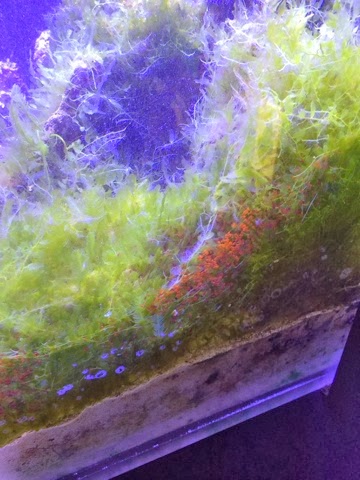 |
| Photo of Tank from Fall 2013 |
 |
| Photo of Tank from Fall 2015 |
By Matthew Watowich
Saturday, May 9, 2015
The Tank is Nearly Back to Normal!!!
Good news!!!! The clownfish have readjusted to their original tank and are happy being there again. In addition to the clownfish, there are also nine snails: 3 Margarita Snails, 3 Netrite Snails, and 3 Mexican Turbo Snails. These snails are doing a great job maintaining the algae growth in the tank, yet we would like to add a sea hare to the tank, which would aid these snails in algae maintenance. We also had a representative from Fish Gallery, an amazing fish supply store, come in to identify the algae that is still growing in our tank. However, the man who came in said that he had never seen the type of algae we have growing in our tank. It is a dark brown, slimy, hairy algae that could possibly be a new species. When testing the chemical balances of the museum's clownfish tank, I found that the calcium levels were extremely slow, about 260 ppm versus the 400 ppm that they should be. I concluded that this must be caused by one of two things: the snails pulling more calcium than we expected out of their water to build their shells or a faulty test kit. I should be able to determine if it was caused by a faulty test kit sometime next week because we ordered another kit to compare the results. If it is not a faulty test kit, I will assume that the snails are pulling more calcium out of the water than we expected, but I will have to do more experiments to determine if this theory is correct. However in the mean time, we will continue to add calcium supplements to the tank to "normalize" the levels of calcium in the tank.
Sunday, April 26, 2015
The Clownfish are Back!!!
After a few weeks of working on cleaning the original tank, we finally got the balance of chemicals to be able to support clownfish. Because of this we were able to add the clownfish back to the tank. To do this, we had to put the clownfish in a small bowl. We did this so that we could rest the bowl in the water and let the clownfish adjust to the water in the tank. If we had placed the fish directly into the tank, they would have been shocked by the difference in temperature and water quality.

The clownfish were pretty angry while being moved because moving from one area of water to another tends to cause a lot of stress on the fish. Another reason that the clownfish were mad is because the box that we placed them into while they were being moved was small, causing them to be crowded together. Other interesting animals that we have recently added to the tank are 3 Mexican Turbo Snails and 3 Nerite Snails. Mexican Turbo Snails are large for snails, about 1.5-2 inches in diameter, and are white and sometimes having a shiny surface. On the other hand, Netrite Snails are smaller, about 0.5 inches in diameter, and have a white and black striped surface. We added these snails so that they would clean some of the algae that has been growing on the rocks and sand of the tank. Another way that we are dealing with this abundance of algae is by pulling out individual rocks and manually cleaning them.
Saturday, April 11, 2015
Water Tests and Lots of Algae
I just visited the HMNS to work on the clownfish tank. I took a sample of the tank water downstairs, where I would be able to perform multiple tests to determine the levels of different chemicals in the water. I tested for pH, nitrites, nitrates, ammonia, phosphates, and carbonate hardness; I, however, was most concerned with the calcium test. This is because in the previous weeks, Christine and I have found that all of the chemical levels in the tank are normal except for the calcium, which is a little low. I found that the calcium was lower than it should be, but it was higher than it has been in the previous weeks. It was about 320ppm, which is a 20ppm increase from the 300ppm that it used to be during the past few weeks. To further increase the calcium levels, I added calcium supplement to the tank. Christine and I have been adding this calcium supplement once a day for the past couple of weeks, and the calcium levels have slowly begun to rise.
One interesting thing that I found while at my internship was that the clownfish tank had a thick layer of algae covering the bottom. This is interesting because I visited the museum two weeks ago and saw almost no algae in the tank. It was so impressive that algae could grow from barely being in the tank to coating the entire floor in just two weeks.
One interesting thing that I found while at my internship was that the clownfish tank had a thick layer of algae covering the bottom. This is interesting because I visited the museum two weeks ago and saw almost no algae in the tank. It was so impressive that algae could grow from barely being in the tank to coating the entire floor in just two weeks.
Thursday, March 5, 2015
Water Tests and Margarita Snails
So much more has been going on at my internship, and it is so exciting! Christine and I took water tests of both the touch tank (in the Hall of Malacology) and the original clownfish tank (in the Hall of Malacology). We found extremely high levels of Nitrates in the touch tank. The nitrate measured at >20ppm (it should be around 0ppm in a healthy tank). Neither her nor I were sure where these high levels of nitrate were coming from. Nitrates are made from ammonia caused by the fish. This ammonia is converted by bacteria to nitrite, where it is then converted into nitrates. However, nitrates are usually kept at low levels by the algae living in the tank because high levels of nitrate can be toxic to fish and invertebrates. To fix these nitrate levels, I suggested that we do a water change on the tank. We would take out around 30% of the water currently in the tank replace it with water containing correct chemical levels. You don't want to do a 100% water change because it can cause the fish and invertebrates to go into shock and die.
Within the original clownfish tank, the chemical levels were more reasonable, but we are going to wait a few weeks to add in the clownfish, just to make sure that the chemical balances will stay constant. However, we noticed algae growing on the rocks that are currently in the tank. To make sure that the algae doesn't get out of control again, Christine and I added margarita snails (Margarites pupillus). These snails are known for eating algae and are able to survive in water conditions that might not be the best for other animals. Hopefully, the water levels will stay constant, and we will be able to add the clownfish back.
Within the original clownfish tank, the chemical levels were more reasonable, but we are going to wait a few weeks to add in the clownfish, just to make sure that the chemical balances will stay constant. However, we noticed algae growing on the rocks that are currently in the tank. To make sure that the algae doesn't get out of control again, Christine and I added margarita snails (Margarites pupillus). These snails are known for eating algae and are able to survive in water conditions that might not be the best for other animals. Hopefully, the water levels will stay constant, and we will be able to add the clownfish back.
Sunday, March 1, 2015
New Updates from my Internship
I haven't posted in a while, mostly because I've been swamped with work, but new things are happening at my internship. First of all, the clownfish tank is almost back up and running. Right now, the tank is empty except for a few cleaned rocks. This is because we wanted to make sure the water qualities were correct before we added in the rest of the cleaned rocks and the fish. We should be able to add them in soon because I tested the water and found that has the correct qualities that clownfish need. We also found some beneficial algae on some of the rocks in the tank, which means that the water has the proper qualities to support life. We're almost done!!! Since, we're almost done, Christine asked me if I could design the new aquarium layout that will be in the Strake Hall of Malacology. I gladly accepted, and originally planned on having the tank house nudibranchs, a beautiful member of Phylum Mollusca that resemble sea slugs.
However, I found that nudibranchs are incredibly hard to care for because they require extremely specific conditions. Because of this, I decided that flame scallops would probably be better for the new tank. I am still in the process of designing the tank layout and what other animals should go into it, but it will be complete soon! If you have any ideas about what you think would look good, please leave a comment.
 |
| A Blue and Yellow Nudibranch |
Monday, January 5, 2015
SHARKS! and Adding to Their Tanks
On Wednesday, November 5, I went to the HMNS to visit Christine Batten, my mentor. I had to be there at 9:00, and Ian had to be to another internship at 8:30, so I decided to just go over with him. At nine, I met Christine inside the Sharks! exhibit because she helps run it. We then went downstairs to the Animal Alcove, a room on the Lower Level that houses lots of animals. She wanted to put some new rocks in the Sharks! exhibit to give them more places to rest. In the Animal Alcove, we picked up some supplies that we would need for the day: water, some plastic bags, and rocks. We went back up to the Sharks! exhibit and piled rocks in the tank in three different locations. We went back to the Animal Alcove to pick up some crabs, which I would be putting in the shark tanks. Before I put the crabs in the shark tank, they had to acclimate to the temperature of the tank, so they didn't die of shock. To acclimate them, I first put them in a plastic bag filled with the water they were used to. I floated the bags in the shark tanks for fifteen minutes. During these fifteen minutes, Christine and I went to check on an existing, empty tank that she and I are planning on putting creatures in. We discussed different things that could go in this tank, and we felt like nudibranchs would be best for this tank. I am currently writing a proposal to get nudibranchs and other supplies for this tank. After checking on this tank, we traveled back down to the shark tank, and I took the crabs out of the floating bags and placed them around the shark tank.
The Texas Ecology exhibit opened up about a week before I visited, and she offered to show me it. Of course I said yes! It was incredible. It was clear that lots of effort had been put into making this exhibit look as real as possible. Each tree in the exhibit had trunks that were living. Christine said that the artists creating the exhibit got living trees and pulled each leaf of individually. She said they then attached fake, but realistic, leaves to where the real leaves were. There was also living Spanish moss hanging from branches that were coming out of the ceiling and walls. There were three animatronic animals, a skunk, a woodpecker, and a rattlesnake. I would defiantly recommend going to the HMNS to see this exhibit as it is just stunning.
Saturday, October 25, 2014
Surprising Results from Water Tests!!
On Wednesday, the 22, I visited the HMNS to work on my tank. Christine was really busy, since she had to teach a lot of classes, so I worked alone. I started off taking water tests of both the tanks, the quarantine and the clownfish tank. 

These are the results from the tests of the quarantine tank. The top one, the purple one, is for the pH of the test. It is purple, which indicates an pH of 7.8. Under that is the ammonia test, which is bright yellow. This indicates a ammonia level of 0ppm, which is great because ammonia can cause fish disease as well as other bad things. Under the ammonia tube is the test for nitrate. It is dark orange, which is really bad. It means that the nitrate levels are between 20-40ppm. It should be yellow and 0ppm. When the nitrate levels are too high it causes fish disease, coral disease, and algae growth. These are all bad things for the tank, which is why we are planning on doing a partial water change to try to lower the nitrate levels. Under that is the test for nitrite, it is right where we want it to be, at 0ppm. This means that the biological filter of the tank is working well.
I then took water test of the clownfish tank. The pH levels were around 8.4, which is still good for the tank; however, we are going to try to bring down that gap between the two pH's. The ammonia levels in the clownfish tank was 0ppm, which is great. The nitrate levels in the clownfish tank were 5ppm, which is slightly too high. However, this is most likely caused by just setting up the tank. Usually when you put new water into a tank, there is a slight spike in nitrate levels. However, we expect the levels to go down as the water gets adjusted to the tank. More importantly, the nitrate levels of the tank were 2.0ppm. This is not very good because it can cause fish disease. The high levels of nitrite are most likely caused by the lack of a biological filter in the tank. This is why I believe that we should add a few clean rocks to the tank to start up the biological filter, so that it is ready as soon as we want to put the fish back in it.
As one can see, the chemical levels in the tank differ significantly, which is why I am taking multiple measures to change the levels of each tank, so there see where they should be. I am planning on doing partial water changes and adding just a couple of rocks to the clownfish tank so that the chemical levels balance out.
After taking water tests, I washed the clean rocks that have been taken out of the clownfish tank. I then set them out to air-dry, so that all the parasites on them die. Soon I will start to add the sand, rocks and fish back to the clownfish tank, and it will be back to normal.
My notes from this last internship visit.
Tuesday, October 7, 2014
The Tank is almost clean
Today, October 7, 2014, I went to my internship at the HMNS. I was only there for one and a half hours but it was enough for Christine and I to get lots of stuff done. First, we went to the Sharks! exhibit, which she runs. While there we checked the tanks to make sure they were all running correctly. They have to types of sharks in the exhibit, bamboo sharks and walking sharks. The walking sharks are really funny because when they swim, they look as if they are walking on their fins. After making sure everything was running smoothly in Sharks! We went to the clownfish tank, which was full of water, and began siphoning out the sand and the water. We about 99% of the sand out of the tank, so our next step is to get that last one-percent out by draining the tank and scooping it out manually. After we siphoned as much sand as we could, we began scrubbing the sides of the tank with steelwool-like pads and acrylic blades to clean all the algae and crystalline coral off of the sides. I then left, but I look forward to coming back and finally finishing cleaning the tank.
Saturday, October 4, 2014
Internship Fun!
On Octpber 4, I went to the HMNS to visit the Hall of Malacology for my internship. Over the summer, I had been slowly taking out rocks and cleaning them and putting them into the quarantine tank until only half of the rocks were left. Christine, my mentor, and I, today, decided that we were going to do a massive push on the tank. We pulled all the rocks out and put them in a separate bucket. We didn't clean the rocks today, but we plan to do it next week.

This is what the tank looked like after taking out all the rocks. It was pretty dirty.

We then began siphoning the water and sand from the tank.

This is what the tank looked like after siphoning it for a few minutes. As you can see, we removed a lot of the sand from this side. The bucket we were siphoning the water into filled up, so we had to take it down to the loading dock and dump it out.

Sunday, May 11, 2014
Eleventh Internship Blog
On Friday, May 11, I visited the HMNS for my internship. I tested the water in the quarantine tank to see if it matched up with the water that was in the tank upstairs. Even though we put the same water in the tanks, sometimes, one will find different chemicals in them because the rocks release chemicals naturally. Fortunately, both the tank's chemicals matched up. Because of this, we can start treating the quarantine tank with aphasia killer. One can see a giant aphasia on the picture of the rock below. It is the big clearish, white looking thing on the top of the rock. We don't like treating aphasias in a tank with other things because the chemical that treats the aphasia can kill the fish or other animals in that tank. However, in the quarantine tank, nothing that can be killed by the chemical should be living.

Saturday, April 26, 2014
Tenth Internship Experience
On Friday April 25, I went to the HMNS for my internship. This was one of my favorite times going because I got so much done. I took water tests of the quarantine tank, which we built two weeks ago. I also took water tests of the upstairs tank that we are cleaning. I tested the water for pH, salinity, ammonia, nitrite, and nitrate. The tests for both tanks matched up, which is good because that means that we can start putting rocks from the upstairs tank into the quarantine tank. After I took water tests, I cleaned two rocks from the upstairs tank, and then brought one of them downstairs. We will put this rock into the quarantine tank, next week, after we have time to do a few more water tests on the quarantine tank.
Saturday, April 12, 2014
Ninth Internship Experience
On March 21, I visited the HMNS for my internship. I learned a lot this time because we built the quarantine tank. We built this tank so that we could have a place to put the clean rocks. It also is to help get rid of all of parasites in the tank because we can put chemicals into the quarantine tank that we can't out in the normal tank. The quarantine tank is much more simple than the normal tank because it just has a pump and filter. The normal tank has many more parts to it which is why we can't put many chemicals in it(they could ruin these parts). After building the quarantine tank, we cleaned another tank which contained a lungfish. This tank was covered in algae because it had not been cleaned in a very long time. The staff don't clean the tank that often because the lungfish can survive in many different conditions. It is very adaptable which is why it can survive in many different conditions. 

I then took water tests of the tank that is full of parasites and the quarantine tank. I tested their ammonia levels, carbon hardenss, nitrite levels, ph, and salinity levels. The ammonia levels in the quarantine tank were much higher than the other tank. This is because when you first put water in a new tank this ammonia levels spike. All of the of conditions of the water were the same. Since the ammonia levels will go back down in about a week, next time I go to my internship, we are planning on putting some rocks in the quarantine tank.
We then went on to do a water change on the touch tank that is upstairs. We pumped out about half of the water in the tank into a big bin. We then put in water that had been mixed to match the conditions of the water already in the tank. We let the water circulate a few times, and then it was time for me to go. Overall, I learned a lot this internship time because we did so much.
Sunday, February 23, 2014
Eighth internship blog
On Thursday, the 20, I visited the HMNS for my internship. I got the keys from the front desk and went down the hall to the animal alcove. I got the cart with all of the materials on it from the animal alcove and went upstairs to the fish tank. I pulled out one rock andbegan cleaning it.this rock took me about 30 minutes to clean because there was so much stuff on it. Once I was done cleaning this rock, I put it back in the tank and pulled out a new rock. This rock had even more stuff on it, so I had to spend about 40 minutes getting all of the stuff off of it. Once this rock was done, I got a small rock from the tank. I cleaned this Rockford about 10 minutes because there was not that much stuff on it. I then took out three rocks thati had cleaned the previous week and recleaned them. Each one of these rock took me about 10 minutes to clean, since not much grows back on the rocks in a week. I then put all of the rocks back in the tank and went down to the animal alcove to put my cart away.
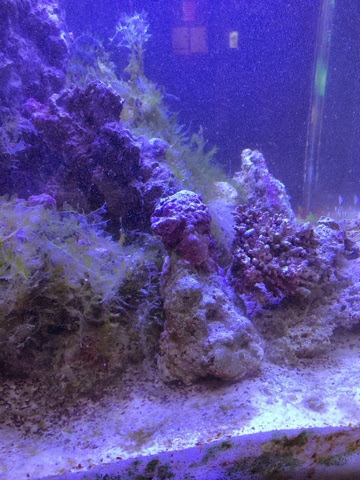 This Is what the tank looks like now.
 This is what the tank used to look like.
This Is what the tank looks like now.This is what the tank used to look like.Sunday, February 9, 2014
Seventh Internship Experience.
Last Thursday, I visited the HMNS for my internship. Christine, my mentor, was not available to help me so I had to clean the tank by myself. This was fun because it gave me a chance to really test out how much I knew about the tank. I started cleaning two rocks that I had previously cleaned, just to make sure nothing else was in them. After I cleaned these two rocks, it started on a small rock that I had never cleaned before. This rock was covered with plant junk, which took me a really long time to get off. I moved on to another rock, which was slightly bigger. This rock didn't have a ton of plant junk on it, but it did have a bristle worms. I had to pick each bristle worm out of each crevice. By the end, I had picked about 5 bristle worms out of this rock. I move onto my last rock. This rock had a lot of long plant junk on it. This plant junk was easier to get off since it was long, so I could just pull it off with my hands. It was then time for me to go, so I quickly cleaned up and went back to school.
Thursday, January 23, 2014
Sixth Internship Experience!
On Tuesday the 21, I visited the Houston Museum of Natural Sciences for my sixth internship experience. Christine was busy doing work so I had to clean the tank by myself. I re-cleaned some of the rocks that I had preciously cleaned and found a few more aiptasias. I then started to clean another rock. This rock was fairly big and took me about twenty minutes to clean. I then cleaned another rock. This one had a ton of plant junk on it. Because of this, the rock took me about thirty minutes. By the end about half of the tank's rocks had been cleaned. I then cleaned up my station and went back to school.
Wednesday, January 15, 2014
Fifth Internship Experience!
On Monday, the 13th, I visited the Houston Museum of Natrual Sciences to work at my internship. Christine Batten, my mentor, was not there to help me because she was sick. This meant that I had to work alone. This turned out to be a good thing because it let me test my knowledge of the tank and equipment. I gathered the equipment and went upstairs to work on the tank. I then quickly re-cleaned some rocks that I had previously cleaned. This didn't take long so I had time to do other rocks. I pt those rocks back in the tank and then I took out another rock. I cleaned that rock of all of the aiptasias, plant junk, and flatworms. This took me about thirty minutes since there was so much plant junk. This plant junk was very hard to get off because it was so stuck. At the end of this rock,it was nearly time for me to leave. I then quickly cleaned off the tank and put my equipment away. I then had to go back to POHS.
Wednesday, January 8, 2014
Fourth Internship Experience
On Monday, January 6, I visited the HMNS again for my internship. This was the first time that I worked independently because Christine, my mentor, had to do some more work. She helped me gather materials and take the top off of the tank. She then went to go do her work and I started to clean rocks. I re-cleaned some of the rocks that I had previously cleaned. I did this just to make sure that all of the flatworms and other junk was off of them. I then moved on to cleaning a new rock. This rock was pretty big so it took me a longer time to clean. I cleaned off most of the junk in the first ten minutes because a lot of the junk on the rock were plants. The plants were pretty long so I could just pluck them off. After most of the big junk was cleaned off, I had to start cleaning the smaller junk on the rock. This took a really long time since I could just pull this small junk off of the rock, I had to scrub it really hard with a toothbrush. After finishing this rock, I placed it back into the tank. As I was doing this Christine had just arrived to help me clean up. We cleaned the surrounding area of water and then took all our materials back down to where they belonged. I felt like I learned a ton this time at my internship because I had to put my skills to the test, since I didn't have the option to ask Christine how to do this or that.
Subscribe to:
Posts (Atom)